Have you ever wondered whether to write wholey or wholly? These two spellings look almost identical, so it is easy to confuse them when writing an email, completing an assignment, or creating content.
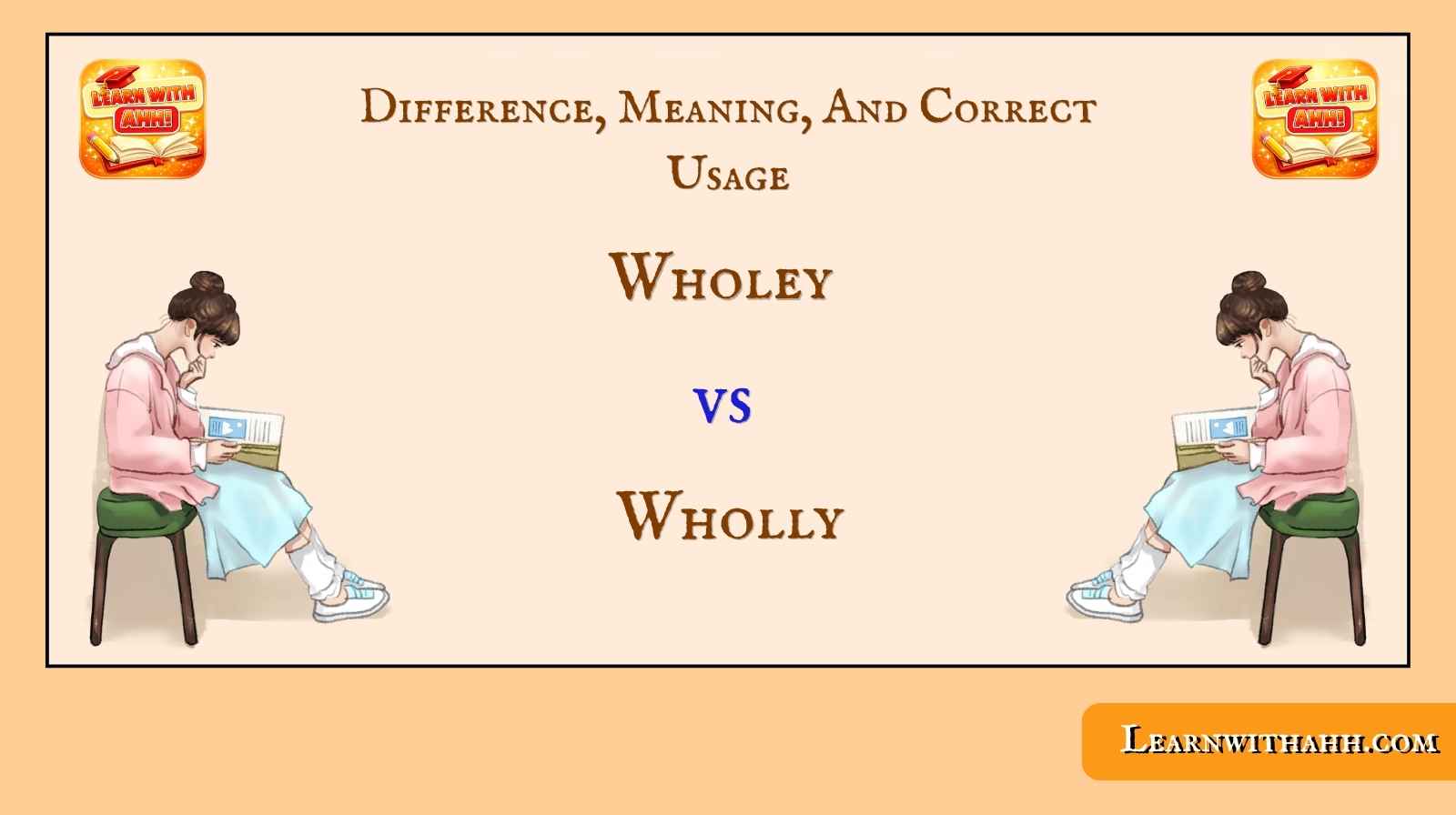
When comparing wholey vs wholly, the key point is simple: wholly is the standard English word meaning completely or entirely, while wholey is generally a misspelling of wholly.
Although the words differ by just one letter, choosing the correct spelling matters when you want your writing to look professional and communicate your message clearly.
In this guide, you will learn the meaning of wholly, why people confuse it with wholey, how to use it correctly in sentences, and which alternatives you can use in everyday English.
What Is the Difference Between Wholey and Wholly?
The primary difference between wholey and wholly is spelling and standard usage. Wholly is a recognized English adverb, whereas wholey is generally considered a misspelling when the intended meaning is completely or entirely.
What Does Wholly Mean?
Wholly is an adverb that means completely, entirely, or fully. It describes the extent to which something is true, complete, or applicable.
According to the Oxford University Press, wholly is a formal word that means completely or totally. You can consult its definition in the Oxford Advanced Learner’s Dictionary.
Examples of wholly in sentences:
- The decision was wholly unexpected.
- I am wholly responsible for the mistake.
- Her explanation was not wholly convincing.
- The project was wholly funded by private investors.
- His argument is wholly different from mine.
In each example, wholly emphasizes the degree or completeness of a situation.
What Does Wholey Mean?
Wholey is generally not the correct spelling when you want to express the meaning of completely or entirely.
For example:
❌ The decision was wholey unexpected.
✅ The decision was wholly unexpected.
❌ I am wholey responsible for the mistake.
✅ I am wholly responsible for the mistake.
The incorrect spelling often occurs because English speakers associate wholly with whole and assume that adding the suffix -ly produces wholey.
However, English spelling does not always follow that pattern.
Quick answer: Use wholly when you mean completely or entirely. In ordinary English writing, avoid wholey unless you are referring to a proper name, brand, or another specific use of that spelling.
How to Use Wholly Correctly in a Sentence
Understanding the meaning of wholly is only the first step. To use it naturally, you also need to understand where it fits in a sentence and which words commonly appear alongside it.
1. Use Wholly to Mean Completely
Wholly can emphasize that something is complete or applies to the full extent described.
Examples:
- The building is wholly owned by the company.
- The information is wholly accurate.
- Her success was not wholly unexpected.
- The organization is wholly independent.
In these sentences, wholly modifies the meaning of the statement by expressing completeness or degree.
2. Use Wholly to Express Total Agreement or Responsibility
You can also use wholly when discussing responsibility, commitment, agreement, or dependence.
Examples:
- I wholly agree with your opinion.
- He accepted that he was wholly responsible for the outcome.
- The business is wholly dependent on online sales.
- She was wholly committed to achieving her goals.
These constructions are especially useful in professional, academic, and formal writing.
3. Use Wholly in Negative Sentences
Wholly frequently appears with negative words such as not to express that something is not completely true.
Examples:
- I am not wholly convinced by his argument.
- The plan was not wholly successful.
- Her explanation is not wholly accurate.
- The results were not wholly unexpected.
Notice the difference between not wholly successful and completely unsuccessful. The first expression means that something was not successful in every respect, but it may have achieved some positive results.
This distinction makes wholly useful when you want to communicate a balanced or nuanced opinion.
Wholey vs Wholly: Examples and Comparison
One of the easiest ways to remember the correct spelling is to compare the two forms directly.
Comparison Table
| Feature | Wholey | Wholly |
|---|---|---|
| Standard English usage | Generally incorrect for the intended meaning | Correct |
| Meaning | Usually a misspelling of wholly | Completely or entirely |
| Part of speech | Not standard for this meaning | Adverb |
| Example | The claim is wholey false. | The claim is wholly false. |
| Suitable for formal writing | No, when intended to mean completely | Yes |
| Common alternatives | None for the intended meaning | Completely, entirely, totally |
Correct and Incorrect Sentence Examples
Here are additional examples to help you recognize the difference.
Example 1: Academic writing
❌ The research was wholey unsuccessful.
✅ The research was wholly unsuccessful.
Example 2: Business communication
❌ Our company is wholey independent.
✅ Our company is wholly independent.
Example 3: Everyday English
❌ I wholly forgot about the meeting.
✅ I completely forgot about the meeting.
The third example deserves attention. Although wholly is a correct word, it does not sound equally natural in every sentence. In everyday conversation, completely forgot is generally more idiomatic than wholly forgot.
The lesson: Correct spelling is important, but natural word choice matters, too.
Why Do People Confuse Wholey and Wholly?

The confusion between these spellings comes from common English spelling patterns, pronunciation, and the relationship between related words.
1. The Relationship Between Whole and Wholly
The word wholly is formed from whole and the suffix -ly.
Although the adjective whole ends in e, the standard adverbial form is wholly, not wholely or wholey.
Consider these related words:
- Whole → Wholly
- Full → Fully
- Complete → Completely
- Total → Totally
These examples show that English word formation does not always follow one simple spelling rule.
For this reason, it is best to memorize wholly as a standard spelling rather than trying to construct it from scratch every time.
2. Similar Pronunciation
In many English accents, wholly and holy sound alike or very similar.
This similarity can make the spelling more confusing, especially for people learning English as a second language.
For example:
- Wholly: The statement is wholly inaccurate.
- Holy: The building is considered a holy place.
Although these words may sound alike, their meanings are different.
Wholly means completely or entirely, while holy relates to something sacred or religious.
3. Typing Errors and Autocorrect
People sometimes type wholey because they remember the word’s meaning but not its exact spelling.
Spellcheckers and grammar tools can help identify such errors, although you should still understand the underlying rule.
For example, if you write:
“The results were wholey unexpected.”
A spelling checker may flag wholey. You can correct the sentence to:
“The results were wholly unexpected.”
Developing familiarity with the correct spelling will make your writing more accurate over time.
Real-Life Example: Choosing Between Wholey and Wholly

Consider a student named Sarah who is preparing an academic assignment about environmental protection.
During the first draft, Sarah writes:
“The success of environmental policies depends wholey on public participation.”
She understands the intended meaning: environmental policies depend completely on public participation. However, she has used the wrong spelling.
Step 1: Identify the Intended Meaning
Sarah asks herself what she wants to communicate.
She wants to emphasize the extent of the dependence, rather than describe something that is physically whole.
This tells her that she needs an adverb meaning completely or entirely.
Step 2: Choose the Correct Word
Sarah compares wholey with wholly and checks a reputable dictionary.
She discovers that wholly is the standard spelling for the intended meaning.
She corrects her sentence:
“The success of environmental policies depends wholly on public participation.”
Step 3: Check Whether the Sentence Sounds Natural
Although the corrected sentence is grammatically acceptable, Sarah considers whether wholly is the most appropriate word.
The phrase “depends wholly on” communicates complete dependence. However, public participation might be only one of several factors affecting environmental policy.
If she wants to make a more balanced argument, she could write:
“The success of environmental policies depends largely on public participation.”
Alternatively, if she genuinely intends to emphasize complete dependence, she can retain the original meaning:
“The success of environmental policies depends entirely on public participation.”
Step 4: Apply the Lesson to Future Writing
Sarah learns two useful lessons from this example.
First, she must use the correct spelling: wholly, not wholey.
Second, she should choose words according to their meaning and context instead of assuming that every grammatically correct word is the most natural option.
She applies these lessons to future assignments, emails, and reports.
This example illustrates a practical editing method: identify the intended meaning, select the correct spelling, and then check whether the word communicates the intended message naturally.
The scenario is illustrative rather than a report of an actual student’s experience, but the editing process can be applied to real writing.
Wholly vs Completely vs Entirely: Which Word Should You Use?

Although wholly, completely, and entirely have similar meanings, their usage can differ depending on context.
Wholly vs Completely
Both words can express that something is complete or total.
Examples:
- The company is wholly owned by its founders.
- The room was completely empty.
- I completely understand your concern.
- The proposal was wholly unacceptable.
Completely is often a natural choice in everyday conversation. Wholly can sound more formal, particularly in professional or academic writing.
Wholly vs Entirely
Entirely is another close synonym of wholly.
Examples:
- I am entirely satisfied with the results.
- The decision was wholly justified.
- The outcome depends entirely on the available evidence.
- The two situations are entirely different.
In many contexts, these words are interchangeable.
However, some expressions sound more natural with one word than another.
For example:
- “I completely understand” sounds natural in everyday English.
- “The property is wholly owned by the company” is a natural formal construction.
- “The decision is entirely yours” is a familiar expression.
Which Word Is Best for Your Sentence?
Use this simple checklist:
| If you want to express… | Consider using… |
|---|---|
| Complete understanding | Completely |
| Complete ownership | Wholly |
| Total dependence | Entirely or wholly |
| A complete absence | Completely |
| A formal statement about responsibility | Wholly |
| A natural conversational expression | Completely or entirely |
These are general preferences, not strict grammatical rules. The best choice depends on the sentence.
2025–2026 Language and Usage Insights

When researching a spelling question such as wholey vs wholly, it is important to distinguish established linguistic facts from unsupported statistics.
What Does the Available Evidence Tell Us?
As of October 2026, the dictionary evidence establishes that wholly is a standard English adverb meaning completely or entirely. The Oxford Advanced Learner’s Dictionary also identifies it as a formal word. Oxford Learner’s Dictionaries
However, there is no verified statistic presented here that measures how many people misspell wholly as wholey during 2025 or 2026. Therefore, assigning a percentage to this spelling error would be misleading.
For practical writing and editing, three evidence-based principles are useful:
- Consult reputable dictionaries. They help establish the accepted spelling, definition, and usage of a word.
- Check the context. A correctly spelled word may still be an unnatural choice for a particular sentence.
- Review the final text. Spelling and grammar checks can help catch errors before publication.
Google’s official guidance on helpful, reliable, people-first content also emphasizes accuracy, usefulness, and providing information that readers can trust. These principles are relevant when publishing grammar guides and educational articles. Read the Google Search Central guide to helpful, reliable content.
The key takeaway is that reliable dictionary definitions and careful examples provide stronger support for this spelling question than invented statistics or unsupported claims about search trends.
FAQs
Q1: Is wholey a real word?
A: Wholey is not the standard spelling when you mean completely or entirely. In that context, use wholly. The spelling may appear in proper names, brands, or other specific contexts.
Q2: Which is correct: wholey or wholly?
A: Wholly is correct when you want to express the meaning completely, entirely, or fully.
For example:
- Incorrect: The statement was wholey inaccurate.
- Correct: The statement was wholly inaccurate.
Q3: What does wholly mean in simple English?
A: Wholly means completely or entirely.
For example, “I wholly agree with you” means “I completely agree with you.”
Q4: Is wholly grammatically correct?
A: Yes. Wholly is a standard English adverb used to express completeness or degree.
For example: “The project was wholly successful.”
Q5: What is the difference between wholly and completely?
A: Both words mean completely or entirely in many contexts.
However, completely is common in everyday conversation, while wholly often appears in formal, academic, and professional writing.
For example:
- I completely understand.
- The organization is wholly independent.
These are usage preferences rather than absolute rules.
Q6: Why is wholly spelled with two Ls?
A: The spelling wholly follows the established formation of the adverb from whole and the suffix -ly. The final e is dropped, and the resulting spelling contains two consecutive ls.
The correct spelling is wholly, not wholey or wholely.
Q7: Can I use wholly in academic writing?
A: Yes. Wholly is appropriate for academic writing when it expresses the intended meaning.
For example:
“The findings were not wholly consistent with the original hypothesis.”
This sentence communicates that the findings did not agree with the hypothesis in every respect.
However, always choose the word that expresses your intended meaning most precisely.
Q8: What are the best alternatives to wholly?
A: Common alternatives include:
- Completely
- Entirely
- Totally
- Fully
- Altogether
These words are not interchangeable in every sentence. For example, “I fully understand” and “I completely understand” are natural expressions, while other constructions may require a different choice.
Check the meaning and context before replacing one word with another.
Conclusion:
The difference between wholey and wholly is straightforward once you understand the meaning and spelling of the correct word.
Wholly is the standard English spelling when you mean completely, entirely, or fully. Wholey is generally a misspelling in this context.
Remember these key points:
- Use wholly in formal, academic, and professional writing when it fits the sentence.
- Avoid wholey when you intend to express the meaning completely or entirely.
- Use completely or entirely when these alternatives sound more natural.
- Check both spelling and context before publishing your writing.
For example, write “I am wholly responsible for the mistake,” not “I am wholey responsible for the mistake.”
The next time you encounter this spelling dilemma, remember the correct form: wholly, not wholey.
👉 Explore more useful grammar tips and guides on Learnwithahh

Zia Ahmad is a professional grammar blogger with a passion for clear communication, helping readers master English grammar and improve their writing skills with practical, easy-to-understand guidance.