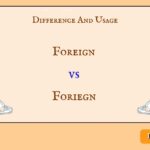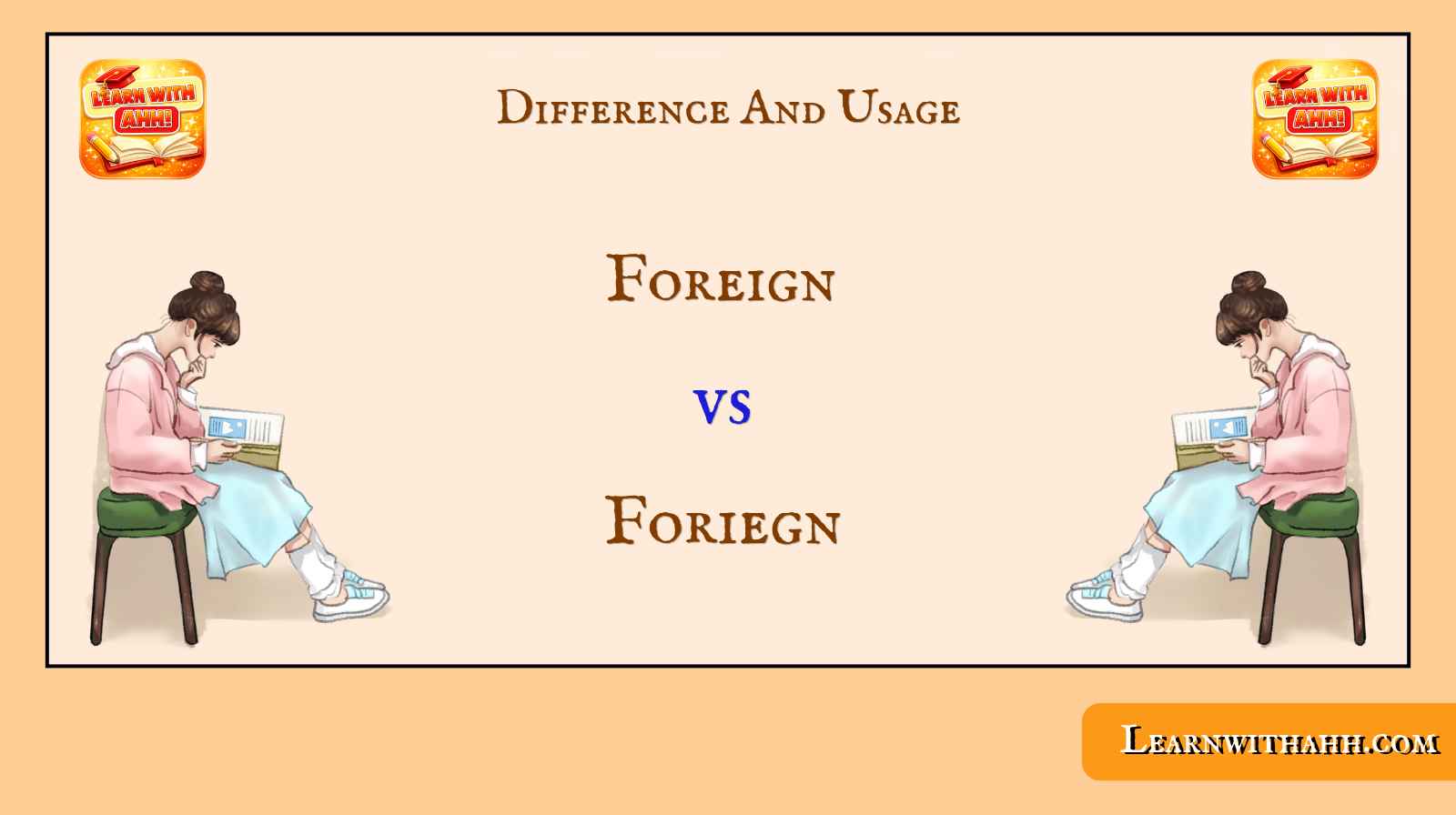
Have you ever been confused about whether to write Foreign vs Foriegn? You’re not alone. Many English learners struggle with these two spellings because they look almost identical. However, only one of them is correct in standard English.
The correct spelling is foreign, while foriegn is a common spelling mistake. Although the incorrect version may look reasonable, especially because of the unusual placement of the letters e and i, it should not be used in formal or informal writing.
Understanding the difference between these spellings can help you improve your spelling, write more confidently, and avoid mistakes in everyday communication.
In this article, you’ll learn the meanings, correct usage, examples, common spelling mistakes, and practical scenarios involving foreign vs foriegn.
Foreign vs Foriegn: Which Spelling Is Correct?
The correct spelling is foreign. The word foriegn is a misspelling and is not accepted as a standard English word.
Although both versions contain nearly the same letters, their arrangement makes a difference. Remember that the correct spelling follows this pattern: F-O-R-E-I-G-N.
Here is a quick comparison:
| Word | Correct or Incorrect | Explanation |
|---|---|---|
| Foreign | Correct | Standard English spelling |
| Foriegn | Incorrect | Common spelling mistake |
Examples:
- Correct: My brother wants to study in a foreign country.
- Incorrect: My brother wants to study in a foriegn country.
- Correct: She enjoys learning foreign languages.
- Incorrect: She enjoys learning foriegn languages.
Always use foreign when referring to something connected with another country or nation.
What Does Foreign Mean?
Foreign is an adjective that describes something belonging to, coming from, or connected with another country or nation.
It can refer to people, languages, cultures, products, businesses, travel, and international relationships.
For example, if someone travels from Pakistan to Canada, Canada is a foreign country from that person’s perspective.
The word can also describe something unfamiliar or different from what someone usually experiences.
Examples of Foreign in Sentences
Here are some examples showing how to use foreign correctly:
- My sister wants to learn a foreign language before traveling abroad.
- Our company imports foreign products from different countries.
- He has several foreign friends from Europe.
- Learning about foreign cultures can broaden your perspective.
- The university offers scholarships to foreign students.
- She enjoys watching foreign movies with subtitles.
- The government introduced new rules for foreign investors.
- I met a foreign tourist at the railway station.
In each sentence, foreign describes something associated with another country or an unfamiliar culture.
What Does Foriegn Mean?
Foriegn is an incorrect spelling of foreign. It does not have a separate meaning and is not recognized as a standard English word.
People commonly make this mistake because they confuse the order of the letters E and I.
For example:
- Incorrect: My uncle works for a foriegn company.
- Correct: My uncle works for a foreign company.
Another example:
- Incorrect: She is interested in foriegn cultures.
- Correct: She is interested in foreign cultures.
Even if readers understand what you mean, using incorrect spelling can make your writing appear less professional.
Therefore, always choose foreign instead of foriegn.
Foreign vs Foriegn: Understanding the Main Difference
The main difference between these two spellings is that foreign is the correct English word, whereas foriegn is simply a spelling error.
There is no difference in pronunciation or meaning because foriegn is not a separate recognized word.
Let’s understand the distinction more clearly:
Spelling Difference
The most noticeable difference is the placement of the letters E and I.
- Foreign: F-O-R-E-I-G-N
- Foriegn: F-O-R-I-E-G-N
Remember that the correct spelling places E before I in this particular word.
Meaning Difference
Foreign has a clear meaning. It describes something related to another country, nation, or culture.
Foriegn has no independent meaning because it is a misspelling.
Grammar Difference
Foreign is an adjective. It describes nouns such as countries, languages, people, products, and cultures.
Foriegn cannot be used as a correct adjective in standard English.
Professional Writing Difference
Using foreign in professional communication, academic assignments, and business documents demonstrates correct spelling.
Using foriegn is a spelling mistake that should be corrected before publishing or submitting your work.
How to Use Foreign in Everyday Situations
The word foreign is commonly used in everyday conversations, professional communication, education, and travel-related situations.
Here are some practical scenarios to help you understand its usage.
Scenario 1: Talking About Foreign Countries
Imagine your friend Ahmed asks you about your travel plans.
Example conversation:
Ahmed: Are you planning to travel anywhere this year?
Bilal: Yes! I want to visit a foreign country, preferably Turkey or Malaysia.
Ahmed: That sounds exciting. I hope you enjoy your trip!
In this conversation, foreign country refers to a country other than the speaker’s own country.
Scenario 2: Discussing Foreign Languages
Suppose your colleague wants to learn another language for professional development.
Example conversation:
Sara: Why are you taking French classes?
Ayesha: I want to learn a foreign language because it could help me find better career opportunities.
Sara: That’s a great idea!
Here, foreign language means a language that is not native to the person.
Scenario 3: Talking About Foreign Products
Imagine you are shopping with a friend and notice products imported from different countries.
Example conversation:
Hassan: Where was this coffee machine manufactured?
Usman: I think it is a foreign product imported from Germany.
Hassan: Interesting! It looks like good quality.
In this situation, foreign product refers to an item manufactured in another country.
Scenario 4: Discussing Foreign Students
Suppose a university is welcoming students from different parts of the world.
Example:
The university provides accommodation and educational support to foreign students who come from different countries.
Here, foreign students refers to students who are from countries other than the country where the university is located.
Email Examples Using Foreign
Email communication is another place where correct spelling matters. Whether you’re contacting an international company, discussing business opportunities, or communicating with someone abroad, using foreign correctly helps maintain professionalism.
Email Example 1: Asking About Foreign Study Opportunities
EMAIL EXAMPLE
Subject: Inquiry About Foreign Study Opportunities
Dear Mr. James,
I hope you are doing well. I am interested in exploring study opportunities in a foreign country. Could you please provide information about available scholarships and admission requirements for international students? I would appreciate your guidance.
Best regards,
Ali Khan
Email Example 2: Discussing Foreign Business Opportunities
EMAIL EXAMPLE
Subject: Foreign Business Partnership Inquiry
Dear Ms. Emily,
I hope this email finds you well. Our company is interested in expanding its operations into foreign markets. We would like to explore potential partnerships with international businesses. Please let us know if your organization would be interested in discussing this opportunity.
Best regards,
Daniel Smith
Email Example 3: Asking About Foreign Language Courses
EMAIL EXAMPLE
Subject: Information About Foreign Language Courses
Dear Mr. Robert,
I am writing to ask about your available foreign language courses. I am particularly interested in learning German and would like to know about the course duration, fees, and registration process. Thank you for your assistance.
Sincerely,
Maria Ahmed

Why Do People Commonly Misspell Foreign as Foriegn?
There are several reasons why people write foriegn instead of foreign.
Confusion About Letter Order
One of the most common reasons is confusion about the placement of E and I. English contains many words with different vowel combinations, which can make spelling confusing.
Unfamiliar Pronunciation
The pronunciation of foreign does not clearly reveal its spelling. The word is pronounced approximately FOR-in, so some learners may find it difficult to remember the correct letter arrangement.
Typing Too Quickly
Sometimes, people type without checking their spelling. Because foriegn looks similar to foreign, they may not immediately notice the mistake.
Lack of Regular Reading
Reading English books, articles, and newspapers regularly helps improve spelling recognition. People who read less frequently may struggle to remember unusual spellings.
Easy Tricks to Remember the Correct Spelling of Foreign
If you frequently confuse foreign and foriegn, these simple tricks can help you remember the correct version.
- Remember the letter order: Foreign is spelled F-O-R-E-I-G-N.
- Think of the word in parts: Remember the sequence “FOR-EIGN” rather than trying to memorize every letter separately.
- Practice writing: Write foreign several times to become familiar with its spelling.
- Read regularly: Seeing the correct spelling in books and articles can improve your memory.
- Use spell-check tools: Check unfamiliar words before submitting important documents.
The easiest trick is to remember that foreign has E before I, not I before E.
Common Words Related to Foreign
Learning words related to foreign can also improve your vocabulary and understanding.
| Word or Phrase | Meaning |
|---|---|
| Foreign country | A country other than your own |
| Foreign language | A language from another country or culture |
| Foreign affairs | A country’s relationships with other nations |
| Foreign student | A student from another country |
| Foreign currency | The money used in another country |
| Foreign exchange | The process of exchanging one currency for another |
| Foreign investment | Investment made by individuals or businesses from another country |
| Foreign culture | Traditions and customs associated with another country |
Understanding these expressions will help you use foreign naturally in different situations.
Foreign vs Foriegn: Common Mistakes to Avoid
Even experienced English writers sometimes make spelling mistakes. However, remembering a few simple rules can help you avoid confusing these two versions.
Here are some common mistakes and their corrections:
| Incorrect Sentence | Correct Sentence |
|---|---|
| I want to visit a foriegn country. | I want to visit a foreign country. |
| She speaks three foriegn languages. | She speaks three foreign languages. |
| He works for a foriegn company. | He works for a foreign company. |
| We import foriegn products. | We import foreign products. |
| They welcome foriegn students. | They welcome foreign students. |
Always remember that foreign is the only correct spelling in standard English.
Frequently Asked Questions
1. Is Foreign or Foriegn the Correct Spelling?
Foreign is the correct and standard English spelling. Foriegn is an incorrect spelling and should be avoided in formal and informal writing.
2. Is Foriegn a Real English Word?
No. Foriegn is not a standard English word. It is a common misspelling of foreign, which describes something connected with another country or nation.
3. What Is the Difference Between Foreign and Foriegn?
Foreign is the correct spelling and an adjective used to describe something related to another country. Foriegn is simply a spelling mistake and has no separate meaning.
4. Why Do People Spell Foreign Incorrectly?
People often misspell foreign because they confuse the placement of the letters E and I. Its pronunciation can also make its spelling difficult to remember.
5. How Do You Pronounce Foreign?
Foreign is pronounced FOR-in. It has two syllables and refers to something connected with another country or culture.
6. Can I Use Foreign in Formal Writing?
Yes. Foreign is a standard English adjective and is perfectly acceptable in academic writing, business emails, professional documents, and everyday communication.
7. What Is the Plural of Foreign?
Foreign does not have a plural form because it is an adjective, not a noun. However, it can describe plural nouns, such as foreign countries, foreign languages, and foreign products.
8. What Are Some Synonyms for Foreign?
Depending on the context, synonyms for foreign include overseas, international, external, alien, and unfamiliar. However, these words do not always have exactly the same meaning.
Conclusion
Understanding the difference between foreign vs foriegn is simple once you remember the correct spelling. Foreign is the only standard English spelling, while foriegn is an incorrect version that results from confusing the order of the letters E and I.
Whether you are writing about foreign countries, foreign languages, international businesses, or foreign cultures, always use foreign to communicate clearly and professionally.
A simple way to remember it is: F-O-R-E-I-G-N = Foreign (Correct).
Practice using this word in everyday sentences and emails, and you’ll become more confident in your English spelling.
👉 Explore more useful grammar tips and guides on Learnwithahh

Zia Ahmad is a professional grammar blogger with a passion for clear communication, helping readers master English grammar and improve their writing skills with practical, easy-to-understand guidance.