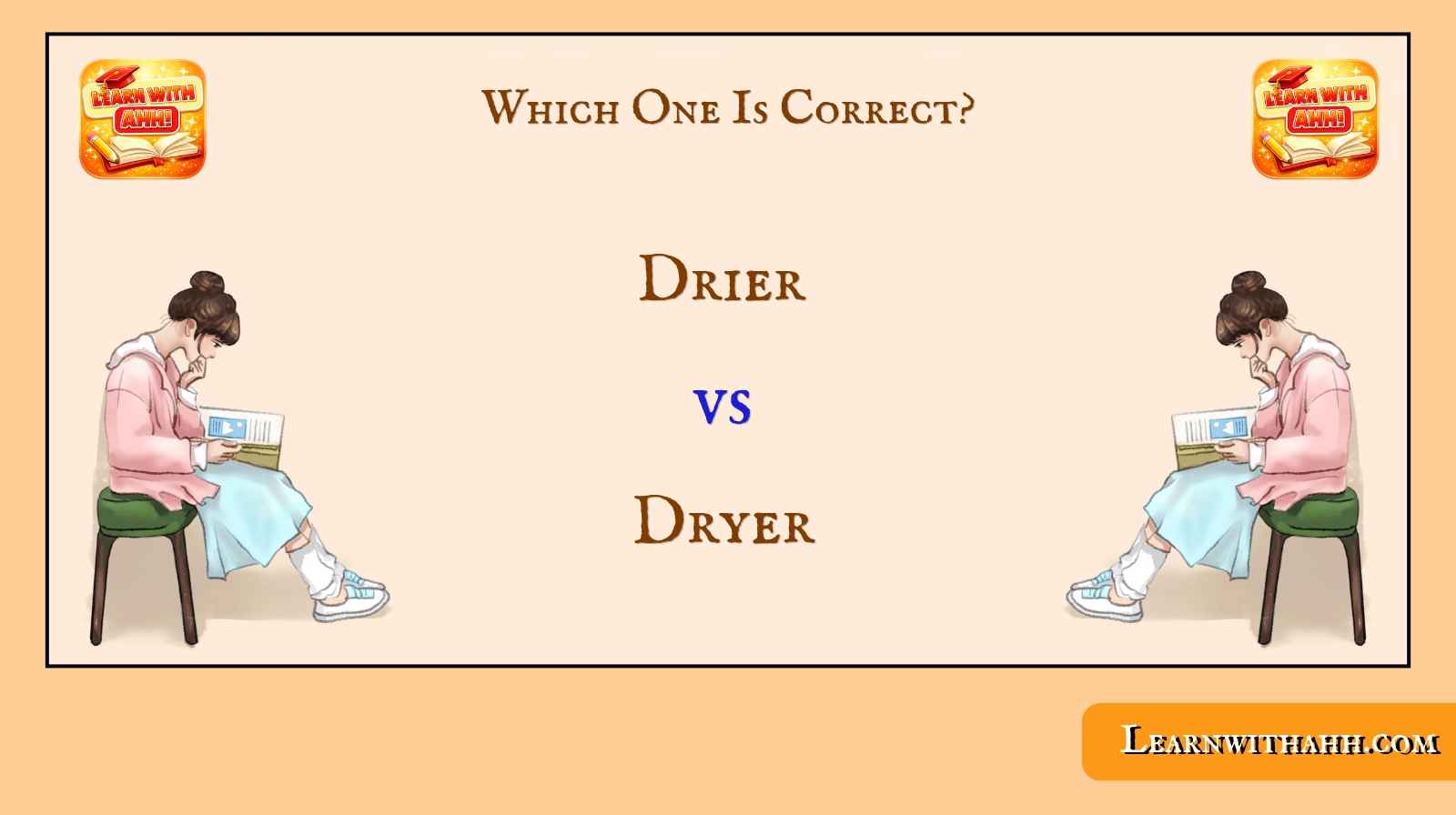
Both Drier vs Dryer are correct English words, but they have different meanings and uses. Although they sound exactly alike, choosing the right spelling depends on the context of your sentence.
Many English learners confuse these two words because both are associated with the idea of becoming dry. However, drier is usually an adjective or comparative form of dry, while dryer is generally a noun referring to a machine or device that removes moisture.
For example, you might say, “The weather is getting drier,” when describing a lack of moisture. On the other hand, you would say, “I put my clothes in the dryer,” when talking about a household appliance.
Understanding the difference between these words can help you avoid spelling mistakes in emails, school assignments, professional documents, and everyday conversations.
In this article, we will explain drier vs dryer, their meanings, grammatical differences, and correct usage with practical examples and real-life scenarios.
Drier vs Dryer: Quick Answer
Both spellings are correct, but they are used in different situations.
- Drier: The comparative form of the adjective dry. It means having less moisture than something else.
- Dryer: A noun that usually refers to a machine or device used to remove moisture from clothes, hair, or other materials.
Here are two simple examples:
- Drier: The weather is becoming drier as summer approaches.
- Dryer: Sarah bought a new clothes dryer for her laundry room.
Remember this simple distinction: Drier describes something that is less wet, while dryer usually names a machine that makes something dry.
What Does Drier Mean?
The word drier is the comparative form of the adjective dry. It describes something that contains less moisture than another thing or has become less wet.
When comparing two objects, places, conditions, or situations, you can use drier to explain which one has less water or moisture.
For example, if one towel contains less water than another, you can describe it as the drier towel.
Similarly, if one region receives less rainfall than another, you can say that it has a drier climate.
Drier is commonly used when discussing:
- Weather conditions and climates.
- Clothes, towels, and other fabrics.
- Skin and hair conditions.
- Soil and agricultural environments.
- Food and other materials containing moisture.
Examples of Drier in Sentences
Here are some examples to help you understand how to use drier correctly.
- The weather is getting drier as the summer season approaches.
- This towel is drier than the one hanging in the bathroom.
- My skin becomes drier during the winter months.
- The northern region has a drier climate than the coastal area.
- Leave the clothes outside for another hour so they become drier.
- The soil looks drier than it did yesterday.
- My hair feels drier after using that shampoo.
- This bread is drier than the one we bought last week.
In each example, drier compares the moisture level of something.
Scenario 1: Using Drier in a Professional Email
Imagine that Emma works in an agricultural company. She needs to inform her manager that the soil in one section of the farm has less moisture than the other sections.
Here is how she might write her email:
Hi Daniel,
I wanted to share a quick update regarding the soil conditions in the northern section of the farm. After checking the samples, I noticed that the soil in this area is drier than the other sections. We may need to adjust the irrigation schedule to maintain suitable moisture levels. Please let me know if you would like me to arrange another inspection.
Best regards,
Emma
Why is drier correct here?
Emma is comparing the moisture levels of two areas of soil. Since she is describing something that contains less moisture, drier is the correct word.
Scenario 2: Using Drier in Everyday Conversation
Imagine two friends, Olivia and James, are discussing their clothes after washing them.
Olivia: Are these clothes ready to wear?
James: Not yet. The clothes on the balcony are much drier than the ones inside.
Olivia: Okay, I’ll check them again in a little while.
Why is drier correct here?
James is comparing two groups of clothes based on how much moisture they contain. Therefore, drier is the appropriate spelling.
What Does Dryer Mean?
The word dryer is primarily a noun that refers to a machine or device designed to remove moisture from something.
It is commonly used for household appliances such as clothes dryers and hair dryers.
A dryer uses heat, airflow, or another drying method to remove moisture from wet materials.
For example:
- A clothes dryer removes moisture from washed clothes.
- A hair dryer blows warm or cool air to dry wet hair.
- An industrial dryer removes moisture from materials used in manufacturing.
Unlike drier, which describes something with less moisture, dryer usually identifies the equipment used to make something dry.
Examples of Dryer in Sentences
Here are some practical examples showing how to use dryer correctly.
- I bought a new dryer for my laundry room.
- My hair dryer stopped working this morning.
- Please remove the clothes from the dryer when they are finished.
- We need a larger dryer for the hotel laundry department.
- Sarah uses a hair dryer every morning.
- The washing machine is working, but the dryer needs repair.
- My mother prefers using an electric dryer instead of drying clothes outside.
- The industrial dryer can handle large quantities of wet materials.
In these sentences, dryer refers to a machine or appliance rather than a comparison of moisture levels.
Scenario 1: Using Dryer in a Professional Email
Imagine that Michael works in an office and needs to inform his supervisor that the laundry room’s clothes dryer is not functioning properly.
Here is an example of how he could write his email:
Hi Robert,
I wanted to report an issue with the clothes dryer in the staff laundry room. The machine has stopped heating properly, and the clothes are still coming out damp after a complete cycle. Could you please arrange for someone to inspect the dryer and repair it as soon as possible? Thank you for your assistance.
Best regards,
Michael
Why is dryer correct here?
Michael is referring to a physical machine used to dry clothes. Since he is naming an appliance, dryer is the correct word.
Scenario 2: Using Dryer in Everyday Conversation
Imagine that two family members are talking about getting ready for work.
Sophia: Have you seen my hair dryer?
Daniel: Yes, it’s on the bathroom shelf.
Sophia: Thanks! I need to dry my hair before leaving.
Why is dryer correct here?
Sophia is asking about a device used to dry hair. Therefore, dryer is the correct spelling.
Drier vs Dryer: Key Differences Explained
Although these words sound identical, their grammatical functions and meanings are different.
Understanding their differences will make it easier to choose the right spelling when writing.
| Feature | Drier | Dryer |
|---|---|---|
| Main meaning | Less wet or moist | A drying machine |
| Part of speech | Adjective | Noun |
| Root word | Dry | Dry |
| Common usage | Weather, skin, soil, clothes | Hair dryers, clothes dryers |
| Example | The climate is drier here. | The dryer is broken. |
Difference in Meaning
The most important difference is their meaning.
Drier describes something that has less moisture compared with something else.
Example: This towel is drier than that one.
Dryer usually refers to a machine that removes moisture.
Example: The dryer is making a strange noise.
Difference in Grammar
Another important distinction is their grammatical function.
Drier works as a comparative adjective. It modifies a noun by describing its moisture level.
Example: The desert has a drier climate.
Dryer is generally a noun. It identifies a machine or device.
Example: I need to buy a new dryer.
Difference in Everyday Usage
You will commonly encounter drier in conversations about weather, skin, clothes, and environmental conditions.
You will commonly encounter dryer when discussing household appliances, laundry equipment, and hair-care tools.
For example:
- The air feels drier today.
- The dryer is not working properly.
Recognizing the context is usually enough to identify the correct word.
When Should You Use Drier or Dryer?
Choosing between these words becomes easier when you understand what you want to communicate.
Here is a simple way to decide:
Use drier when:
- You are comparing two things based on moisture.
- You are describing weather with less humidity.
- You are talking about something becoming less wet.
- You are comparing the moisture levels of skin, hair, soil, or fabric.
Use dryer when:
- You are referring to a clothes-drying machine.
- You are talking about a hair-drying appliance.
- You are describing industrial drying equipment.
- You are naming a device designed to remove moisture.
Easy Trick to Remember the Difference
Here is a simple memory trick:
Drier = Comparison
Think of the phrase drier than.
Example: My clothes are drier than yours.
Dryer = Machine
Think of a clothes dryer or hair dryer.
Example: I need to repair my dryer.
If you remember these two associations, you will find it much easier to use both words correctly.
Common Mistakes to Avoid When Using Drier and Dryer
Even though the difference is straightforward, people sometimes use these words incorrectly, especially when writing quickly.
Let’s look at some common mistakes.
Mistake 1: Using Dryer Instead of Drier
Incorrect: The weather is getting dryer this month.
Correct: The weather is getting drier this month.
Explanation: The sentence describes changing weather conditions. Since it refers to a decrease in moisture, drier is the appropriate comparative adjective.
Mistake 2: Using Drier Instead of Dryer
Incorrect: I need to buy a new drier for my laundry room.
Correct: I need to buy a new dryer for my laundry room.
Explanation: The sentence refers to a household appliance. Therefore, dryer is the correct noun.
Mistake 3: Confusing Comparative and Noun Forms
Incorrect: This towel is dryer than the other one because I used a machine.
Correct: This towel is drier than the other one because I used a machine.
Explanation: Even though a machine was used to dry the towel, the sentence compares the moisture levels of two towels. Therefore, drier is correct.
Mistake 4: Assuming Both Words Have the Same Meaning
Some people believe that drier and dryer are interchangeable because they sound alike.
However, pronunciation does not determine meaning or spelling.
Always consider the role of the word in your sentence before choosing between them.
Are Drier and Dryer Pronounced the Same?
Yes. In standard English, drier and dryer are pronounced exactly the same way.
Both words sound like DRY-er.
This makes them examples of homophones, which are words that have the same pronunciation but different meanings or spellings.
Other examples of homophones include:
- Their and There
- Flower and Flour
- Right and Write
- Sea and See
- Brake and Break
Because drier and dryer sound identical, you cannot identify the correct spelling by pronunciation alone.
You must understand the meaning and context of the sentence.
Is Drier or Dryer More Common in American and British English?
Both spellings are used in American and British English, and their basic meanings remain the same.
There is no major regional spelling difference between these words.
| English Variety | Drier | Dryer |
|---|---|---|
| American English | Correct | Correct |
| British English | Correct | Correct |
| Canadian English | Correct | Correct |
| Australian English | Correct | Correct |
For example, an American writer might say, “The weather is getting drier,” while a British writer could use exactly the same sentence.
Similarly, both might refer to a clothes dryer as a dryer.
The important thing is not the regional variety of English but the meaning you want to express.
Frequently Asked Questions
1. Is Drier or Dryer the Correct Spelling?
Both drier and dryer are correct English spellings. Drier is the comparative form of dry, while dryer is generally a noun referring to a machine that removes moisture.
2. Is Drier a Real English Word?
Yes. Drier is a standard English word. It describes something that contains less moisture than another thing.
Example: The air is drier today than it was yesterday.
3. Is Dryer a Real English Word?
Yes. Dryer is a standard English noun commonly used for machines that remove moisture from clothes, hair, and other materials.
Example: My clothes dryer needs maintenance.
4. What Is the Difference Between Drier and Dryer?
The main difference is their meaning. Drier describes something with less moisture, whereas dryer usually refers to a machine used for drying.
5. Should I Write Clothes Drier or Clothes Dryer?
Clothes dryer is the standard and widely accepted spelling when referring to a machine used to dry clothes.
Example: I put the wet clothes in the clothes dryer.
6. Is It Hair Drier or Hair Dryer?
Hair dryer is the standard spelling when referring to an electrical device used to dry hair.
Example: Emma bought a new hair dryer last weekend.
7. Is Drier the Comparative Form of Dry?
Yes. Drier is the comparative form of the adjective dry. It is used when comparing the moisture levels of two things.
Example: This towel is drier than the other one.
8. Are Drier and Dryer Homophones?
Yes. Drier and dryer are homophones because they have the same pronunciation but different spellings and meanings.
9. Can I Use Dryer When Describing Weather?
Generally, no. When comparing weather conditions based on moisture, drier is the correct choice.
Example: The climate is becoming drier every year.
10. How Can I Remember the Difference Between Drier and Dryer?
Remember that drier means less wet, while dryer usually means a drying machine. You can also associate drier with the phrase “drier than” and dryer with “clothes dryer.”
Final Thoughts on Drier vs Dryer
Understanding the difference between drier vs dryer is easier than it might initially seem.
Both words are correct English spellings, but they serve different purposes in a sentence.
Use drier when describing something that has less moisture than something else. It is the comparative form of the adjective dry.
Use dryer when referring to a machine or device that removes moisture from clothes, hair, or other materials.
For example, “The weather is getting drier” is correct because it describes a change in moisture levels. However, “I bought a new dryer” is correct because it refers to a machine.
The easiest way to remember the difference is to associate drier with comparison and dryer with machines.
Once you understand this simple distinction, you can confidently use both words in everyday conversations, emails, academic writing, and professional communication.
👉 Explore more useful grammar tips and guides on Learnwithahh

Zia Ahmad is a professional grammar blogger with a passion for clear communication, helping readers master English grammar and improve their writing skills with practical, easy-to-understand guidance.