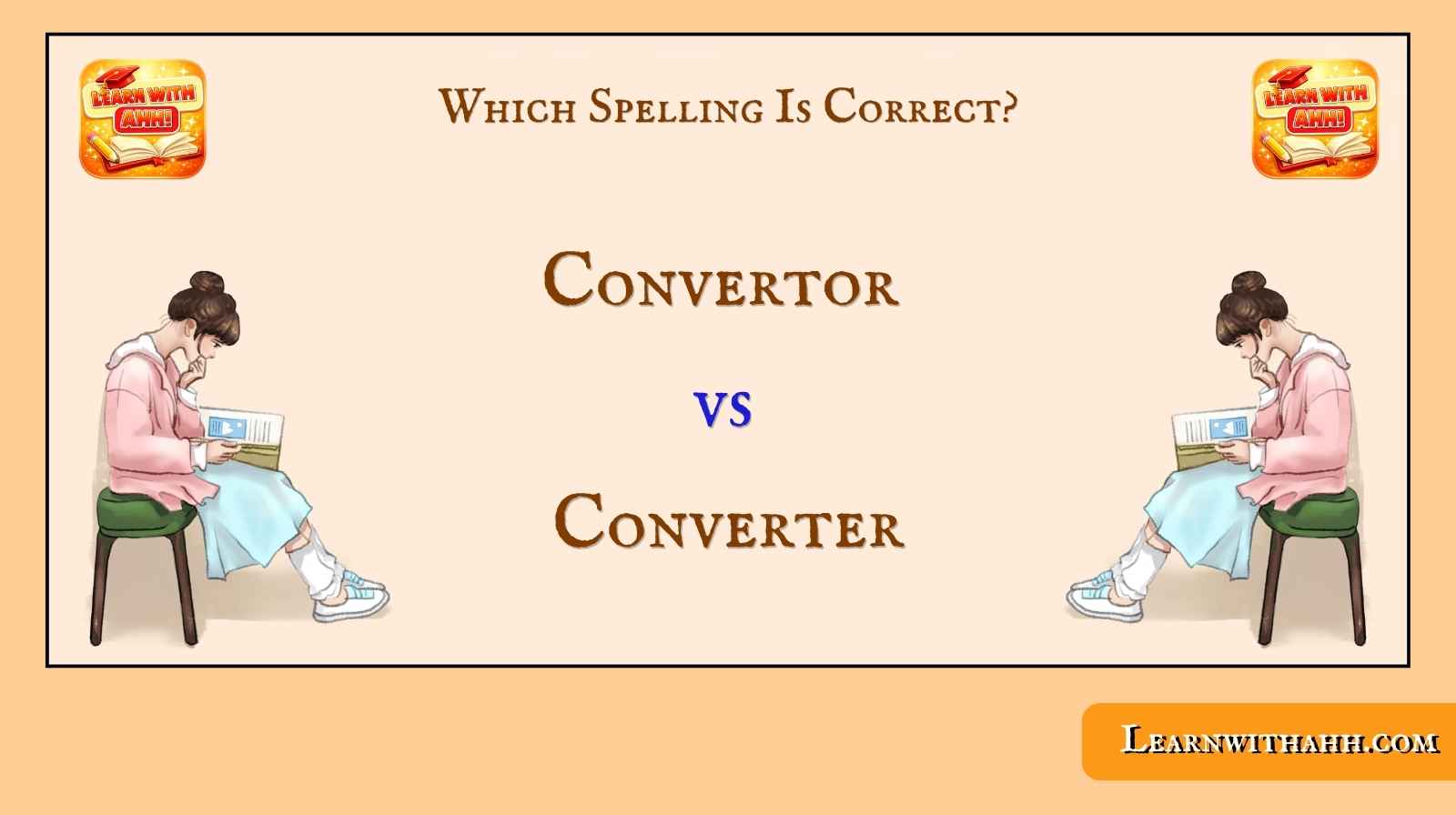
Have you ever written “convertor” and then wondered whether “converter” is the correct spelling? You are not alone. The two words look almost identical and generally refer to the same thing, which makes convertor vs converter a common spelling question.
The simple answer is: converter is the preferred spelling in modern English, especially in general, academic, professional, and technical writing. However, convertor is not simply an invented or meaningless spelling. Major dictionaries recognize it as a variant of converter. Cambridge lists converter with convertor as an alternative form, while Dictionary.com defines convertor as a variation of converter.
So, which one should you use? Let’s look at the difference, examples, usage, and the situations where each spelling may appear.
Convertor vs Converter: The Quick Answer
Converter is the standard and most familiar spelling for most modern English writing.
A converter can be a device, machine, program, or other thing that changes something from one form into another. Cambridge defines a converter as a machine or device that changes something into a different form.
For example:
- I used a currency converter to check the exchange rate.
- This software includes a PDF converter.
- The car needs a new catalytic converter.
- We purchased a voltage converter for the equipment.
Convertor Is a Recognized Variant
Convertor also exists in English. It is listed as a variant or alternative spelling rather than being completely nonexistent.
Dictionary.com defines convertor as “a variation of converter,” while Cambridge includes convertor alongside its main converter entry.
Therefore, it is more accurate to say:
Converter = preferred and widely used spelling
Convertor = recognized but less common variant
If you are writing a new article, essay, email, website, or business document, converter is usually the better choice.
What Does Converter Mean?
Definition of Converter
A converter is something that converts or changes something from one form, type, system, or format into another.
Cambridge gives examples involving devices, computer programs, electrical equipment, and other technical applications.
The word can describe both physical and digital tools.
For example:
Physical device:
The technician installed a new power converter.
Software:
I downloaded a video converter.
Online tool:
Use this currency converter to calculate the amount.
Automotive equipment:
The mechanic replaced the catalytic converter.
Converter and Conversion Are Related
Do not confuse converter with conversion.
A converter is the person, tool, device, or system that performs the change.
A conversion is the process of changing something.
For example:
The converter changed the file format during the conversion.
Cambridge defines conversion as the process of converting something from one thing into another.
Why Is Converter Usually Preferred?
The -er Ending Is Well Established
The spelling converter comes from convert plus the noun-forming suffix -er. Dictionary.com gives its origin as convert + -er and dates its first recorded use to 1525–35.
English has many familiar words formed in a similar way:
- teach → teacher
- drive → driver
- write → writer
- print → printer
- convert → converter
This does not mean every English verb must take -er, but in the case of convert, converter became the established modern form.
Converter Is Used Across Many Fields
The spelling appears naturally in everyday language and specialized terminology.
Common expressions include:
- currency converter
- unit converter
- PDF converter
- video converter
- file converter
- power converter
- voltage converter
- digital converter
- catalytic converter
- torque converter
Collins also lists common collocations such as currency converter and power converter.
This widespread usage makes converter immediately recognizable to most English readers.
Is Convertor a Correct Word?
It would be too simple to say that convertor is always wrong.
Several reputable dictionary sources recognize it as a variant. Cambridge lists “also convertor,” and Dictionary.com identifies it as a variation of converter.
Collins likewise defines convertor as an alternative spelling of converter.
So if you encounter convertor in a technical document, older publication, product name, or specialist context, the word itself is not necessarily an error.
Why Does Convertor Still Appear?
English has accumulated different spelling patterns over hundreds of years. Some alternative forms remain in particular industries, regions, publications, or established names.
For example, Dictionary.com currently includes examples of convertor from BBC and other published sources, including technical references to power systems and automotive equipment.
That means the spelling has real-world usage, even though converter is generally the safer choice.
Convertor vs Converter: Comparison Table
| Feature | Converter | Convertor |
|---|---|---|
| Spelling status | Preferred/common | Variant |
| Meaning | A person, device, or thing that converts | Same basic meaning |
| General writing | Recommended | Usually avoid |
| Professional writing | Recommended | Less common |
| Technical contexts | Very common | Sometimes used |
| Dictionary recognition | Yes | Yes, as a variant |
| Best default choice | Yes | Usually no |
The key point is that this is primarily a usage and preference difference, not a difference in basic meaning.
Convertor vs Converter in Real-Life Writing
Preferred:
I need a reliable file converter for this document.
Less common variant:
I need a reliable file convertor for this document.
The first version is what most readers would expect.
Example 2: Cars
Preferred:
The mechanic inspected the catalytic converter.
Variant:
The mechanic inspected the catalytic convertor.
The second form can be found in real-world usage, but catalytic converter is the familiar standard expression.
Example 3: Currency
Preferred:
I checked the exchange rate using an online currency converter.
This is one of the most natural modern uses of converter.
Example 4: Software
Preferred:
The application includes a built-in video converter.
Here, the converter is software rather than a physical machine.
A 2025–2026 Usage Snapshot
There is an important distinction between dictionary recognition and modern usage frequency.
Current dictionary resources available in 2026 continue to treat converter as the main form while recognizing convertor as an alternative. Cambridge’s current entry labels the word converter and gives “also convertor,” while Dictionary.com separately defines convertor as a variation of converter.
Current 2025–2026 publishing evidence also shows that converter remains deeply established in modern terminology. For example, Dictionary.com includes a 2026 Wall Street Journal example using catalytic converter and a 2026 Los Angeles Times example using converter in a different sense.
At the same time, convertor continues to appear in specialist and product contexts. A 2025 technical publication, for example, uses “convertor” in electrical-engineering terminology, demonstrating that the variant has not disappeared completely.
The practical 2025–2026 takeaway: there is no reliable universal percentage showing exactly how often each spelling is used across all English, but current dictionary and publishing evidence strongly supports converter as the safest general-purpose spelling, while convertor survives as a recognized variant.
A Simple Rule for Choosing the Right Spelling
If you are unsure, choose converter.
Use it in:
- school assignments
- essays
- blogs
- websites
- business emails
- resumes
- product descriptions
- technical explanations
- software documentation
- academic writing
For example:
I used a unit converter to calculate the measurement.
The program contains a PDF converter.
The vehicle has a catalytic converter.
Keep Convertor When the Source Requires It
There are situations where changing convertor to converter may not be appropriate.
You may preserve convertor when:
- quoting a source
- discussing historical wording
- reproducing an official product name
- following a specific technical convention
- referring to an organization’s established terminology
The goal is not to erase every occurrence of convertor. Instead, understand that converter is the normal default for modern general writing.
A Real-Life Example: Technical and Everyday Usage
Consider someone writing a guide about electrical equipment in 2026.
They might find both converter and convertor while researching technical documents. At first, it may seem that both spellings are equally standard. However, checking reputable dictionaries gives more context: Cambridge uses converter as the main entry and lists convertor as an alternative, while Dictionary.com calls convertor a variation of converter.
Now imagine that the same writer is preparing an article for a general audience about power equipment. Using converter makes the terminology immediately familiar:
“A power converter changes electrical energy from one form to another.”
The writer then discovers an older engineering document that spells the word convertor. Instead of assuming the document is necessarily full of spelling mistakes, the writer checks the context. If the original source intentionally uses convertor, preserving that spelling in a quotation is reasonable.
However, if the writer is creating new explanatory content, converter is the clearer choice.
This example demonstrates an important lesson about English spelling: a word can be recognized as a variant without being the best choice for everyday writing. Good editing considers both dictionary status and actual usage.
Common Mistakes With Convertor and Converter
Mistake 1: Calling Convertor Completely Fake
It is inaccurate to claim that convertor does not exist at all.
Cambridge and Dictionary.com both recognize it as an alternative or variant.
Mistake 2: Assuming Both Spellings Are Equally Common
Recognition does not mean equal popularity.
Converter is the much safer choice for ordinary modern writing.
Mistake 3: Mixing Both Forms
Avoid inconsistent writing such as:
The converter changes the signal, while the convertor controls the output.
If both words refer to the same thing, switching spellings unnecessarily can make your writing look inconsistent.
Choose converter and use it consistently.
Mistake 4: Confusing Converter With Conversion
Remember:
Converter = the thing that performs the change.
Conversion = the process of changing something.
For example:
The converter completed the file conversion.
How to Remember the Correct Spelling

Use the “Convert + er” Trick
A simple memory trick is:
Convert + er = Converter
Think of familiar words such as:
- teach → teacher
- drive → driver
- print → printer
- convert → converter
This is not a universal spelling rule, but it is an easy way to remember the preferred form.
You can also memorize common phrases:
currency converter
file converter
unit converter
video converter
power converter
Once these familiar expressions become natural, converter becomes much easier to spell correctly.
FAQs
Q1: Is convertor or converter correct?
A: Converter is the preferred spelling for most modern English writing. Convertor is also recognized as a variant by reputable dictionaries, but it is less common.
Q2: Is convertor a real English word?
A: Yes. Convertor is a recognized variant of converter. Cambridge and Dictionary.com both acknowledge the form.
Q3: What is the difference between convertor and converter?
A: There is generally no major difference in basic meaning. Both can refer to something that converts. The main difference is usage and spelling preference, with converter being the more familiar modern form.
Q4: Which spelling should I use in an essay?
A: Use converter. It is the clearer and more widely recognized choice for academic and general writing.
Q5: Is convertor used in British English?
A: It can be found in British English, but that does not make it the exclusive British spelling. Cambridge lists converter as the main entry and convertor as an alternative.
Q6: Is “catalytic converter” or “catalytic convertor” correct?
A: Catalytic converter is the standard and familiar expression. Catalytic convertor can be found as a variant, but catalytic converter is the better choice for general writing.
Q7: Why do people spell converter as convertor?
A: The confusion likely comes from English noun-forming patterns. Many words use -or, such as actor and operator, while others use -er, such as teacher and driver. In the case of convert, converter became the dominant modern form.
Q8: Can I use convertor in technical writing?
A: Yes, if it is required by a particular technical source, standard, product name, or established terminology. Otherwise, converter is usually the safer and more familiar choice.
Conclusion
When deciding between convertor vs converter, choose converter for most modern English writing. It is the familiar and preferred form used across technology, software, electronics, automobiles, business, and everyday communication.
Convertor is not simply a nonexistent spelling. Reputable dictionaries recognize it as a variant, and it still appears in some technical, historical, and specialist contexts.
So the easiest rule to remember is:
Converter = preferred modern spelling
Convertor = recognized but less common variant
If you’re writing your own sentence, article, assignment, or professional document, converter is the safest choice.
👉 Explore more useful grammar tips and guides on Learnwithahh

Zia Ahmad is a professional grammar blogger with a passion for clear communication, helping readers master English grammar and improve their writing skills with practical, easy-to-understand guidance.