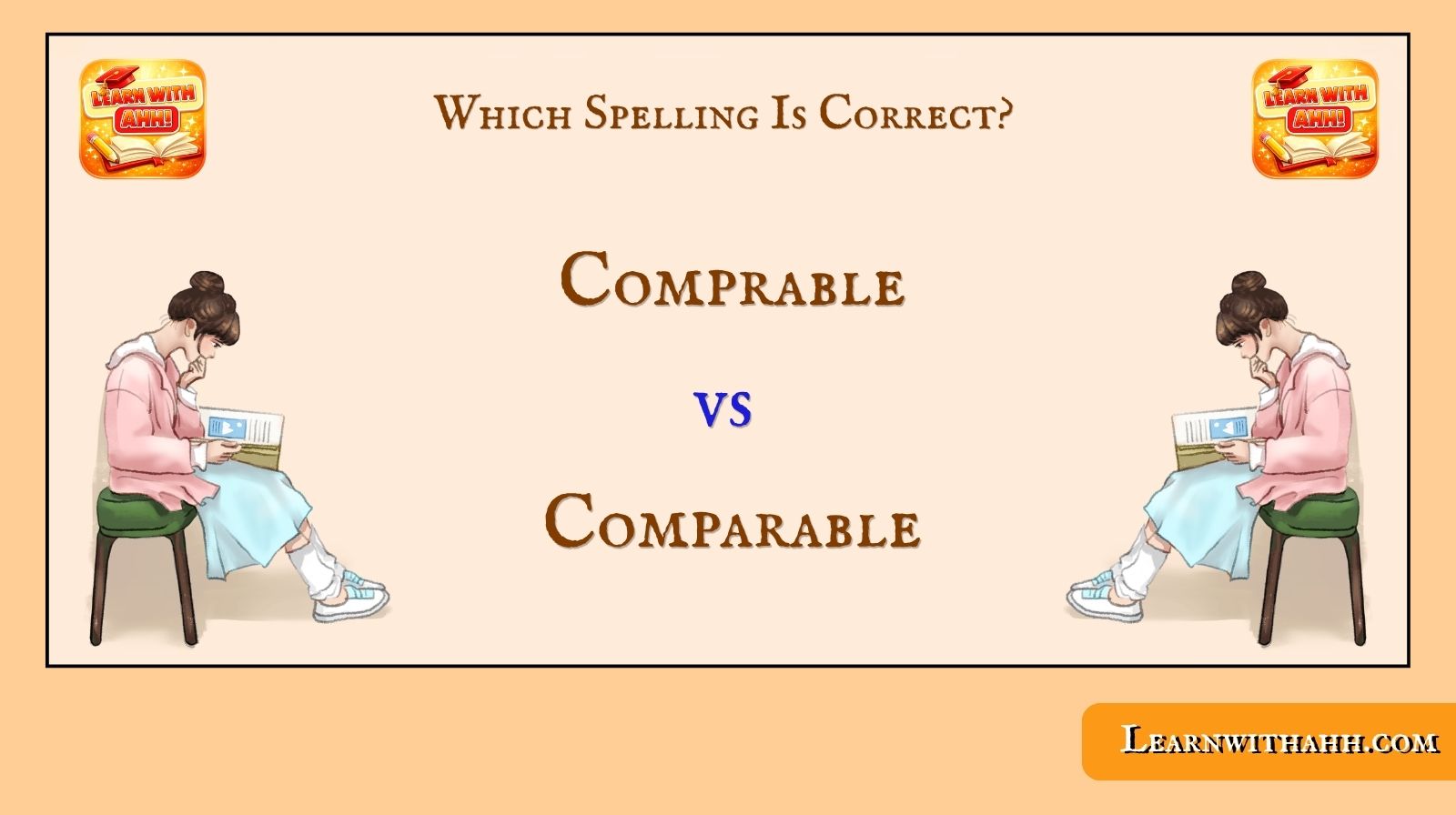
Have you ever typed “comprable” and wondered whether it is the correct spelling? You are not alone. Comprable vs comparable can be confusing because the two forms look almost identical, and the pronunciation can make the missing a easy to overlook.
The correct spelling is comparable. Comprable is a misspelling of the standard English word comparable. Major dictionaries define comparable as something similar enough in size, amount, quality, or other characteristics to be compared with something else.
In this guide, you will learn the difference between comprable and comparable, what comparable means, how to use it correctly, and simple ways to remember its spelling.
Comprable vs Comparable: Which Is Correct?
The answer is straightforward: comparable is the correct spelling in standard English.
Comparable Is the Correct Spelling
Comparable is an adjective meaning “similar enough to be compared” or “worthy of comparison.”
For example:
- The two cars have comparable prices.
- The students achieved comparable results.
- These two products are of comparable quality.
- Her salary is comparable to that of her colleagues.
Cambridge Dictionary defines comparable as similar in size, amount, or quality to something else.
Comprable Is a Misspelling
Comprable is not the standard spelling of the English adjective.
The problem usually occurs because people accidentally leave out the second a:
Compare → Comparable
not:
Compare → Comprable
A dictionary entry for comprable identifies it specifically as a misspelling of comparable.
Quick Comparison
| Spelling | Correct? | Meaning |
|---|---|---|
| Comparable | ✅ Yes | Similar enough to be compared |
| Comprable | ❌ No | Misspelling of comparable |
Easy answer: Always use comparable in formal, academic, professional, and general English writing.
What Does Comparable Mean?
The word comparable describes two or more things that have enough similarities to make a meaningful comparison.
Comparable Meaning
According to Cambridge Dictionary, comparable means similar in size, amount, or quality to something else.
For example:
The two houses are comparable in size.
This means the houses are similar enough in size to be compared.
Another example is:
The two phones offer comparable performance.
Here, comparable means that their performance is similar enough for someone to compare them.
Comparable as an Adjective
Comparable is an adjective, so it normally describes a noun.
Examples:
- comparable prices
- comparable salaries
- comparable results
- comparable quality
- comparable performance
- comparable opportunities
You can also use it after a linking verb:
The two products are comparable.
Their academic results were comparable.
Dictionary.com also gives meanings including “capable of being compared,” “worthy of comparison,” and “usable for comparison.”
Comparable Does Not Mean Exactly Equal
One important point is that comparable does not necessarily mean identical.
For example:
The two laptops have comparable prices.
This does not mean they cost exactly the same amount. It means their prices are sufficiently similar to be compared.
So, comparable is often closer to similar, similar in level, or roughly equivalent than to exactly equal.
Why Do People Spell Comparable as Comprable?
The spelling mistake comprable is understandable because the pronunciation of comparable can make the spelling difficult to hear.
The Missing “A” Problem
The correct spelling contains:
C-O-M-P-A-R-A-B-L-E
The commonly misspelled version removes the a after “par”:
C-O-M-P-R-A-B-L-E
Compare them carefully:
- ✅ Comparable
- ❌ Comprable
The missing letter is easy to overlook when typing quickly.
Pronunciation Can Cause Confusion
Dictionary sources give pronunciations for comparable that can make the internal vowels less obvious in normal speech.
This is a common English spelling issue: pronunciation does not always reveal every letter in a word.
For example, when you say comparable quickly, you may not clearly hear every vowel. Therefore, remembering the written structure is more reliable than spelling the word entirely from its sound.
A Simple Spelling Trick
Break the word into parts:
compare + able → comparable
Think:
If something is able to be compared, it is comparable.
This gives you a useful mental connection:
compare → comparable → comparability
How to Use Comparable Correctly in a Sentence
The easiest way to understand comparable is to see it in everyday sentences.
Examples With “Comparable To”
The construction comparable to is very common.
Examples:
This phone offers performance comparable to a much more expensive model.
Her experience is comparable to that of a senior employee.
The new building is comparable to the old one in size.
The company’s prices are comparable to those of its competitors.
The Chicago Manual of Style notes that “comparable to” is an acceptable construction and discusses its modern usage alongside “comparable with.”
Examples With “Comparable With”
Comparable with is also possible, particularly when emphasizing comparison between things.
Examples:
The results are comparable with those of previous studies.
The new system is comparable with the older version.
His performance is comparable with that of other experienced players.
However, comparable to is extremely common in modern English, so you will frequently see that form in everyday and professional writing.
Incorrect vs Correct Examples
| Incorrect | Correct |
|---|---|
| The two products have comprable prices. | The two products have comparable prices. |
| Their results are comprable. | Their results are comparable. |
| These salaries are comprable to each other. | These salaries are comparable to each other. |
| The two services offer comprable quality. | The two services offer comparable quality. |
A Real-Life Example: Comparable in Professional Writing
Imagine that a company is evaluating two software platforms before making a purchase. Platform A costs $500 per year, while Platform B costs $525 per year. Their prices are not exactly the same, but they are close enough for a reasonable comparison.
A business report might say:
“The annual subscription costs of the two platforms are comparable, although Platform B has additional reporting features.”
This sentence uses comparable correctly because the prices are similar but not identical.
Now imagine that an employee writes:
“The annual subscription costs are comprable.”
The reader will probably understand what the writer intended. However, comprable is still an incorrect spelling. In a business report, proposal, email, or presentation, the standard form should be comparable.
The same principle applies to academic writing. Suppose two studies investigate similar groups of participants using related methods. A researcher might write:
“The findings from the two studies are comparable.”
Cambridge’s dictionary examples include academic and research contexts where results, groups, measurements, and information are described as comparable.
This shows why learning the correct spelling matters beyond a simple spelling test. The word appears naturally in business, education, research, technology, and everyday comparisons.
Comparable: 2025–2026 Usage Snapshot
There is an important distinction between usage evidence and search-volume statistics. Authoritative dictionaries do not currently publish a reliable 2025–2026 figure showing how many people specifically misspell comparable as comprable. Therefore, giving an exact “percentage of people who make this mistake” would be misleading.
Current Dictionary Evidence
Current dictionary resources continue to recognize comparable as the standard English form. Cambridge lists it as a C1-level adjective, meaning similar in size, amount, or quality.
Dictionary.com currently lists three main senses for comparable:
- Capable of being compared.
- Worthy of comparison.
- Usable for comparison or similar.
Dictionary.com also lists related forms such as comparability and comparably, showing that the spelling pattern extends into related vocabulary.
Examples From 2025–2026
Current dictionary usage examples show comparable appearing in modern reporting and research contexts. For example, Dictionary.com currently includes a 2025 example concerning Finland and UK defense spending and several 2026 examples involving scientific research, technology, employment, and other comparisons.
This current usage reinforces an important point: comparable remains an active, standard word in contemporary English, while comprable should not replace it in standard writing.
Comparable vs Similar: Are They the Same?
Comparable and similar are closely related, but they are not always interchangeable.
Comparable
Use comparable when two things have characteristics that make a meaningful comparison possible.
The two apartments have comparable monthly rents.
The focus is on their suitability for comparison.
Similar
Use similar when you simply want to say that two things resemble each other.
The two apartments have similar designs.
The focus here is on resemblance.
Simple Rule to Remember
Think of the distinction this way:
Similar = alike in some way
Comparable = similar enough to compare
For example:
These two cars look similar.
and:
These two cars have comparable fuel efficiency.
Both sentences are correct, but they emphasize different ideas.
How to Remember the Correct Spelling of Comparable
If you frequently type comprable, use one of these simple memory techniques.
Remember “Compare + Able”
The easiest trick is:
COMPARE + ABLE = COMPARABLE
The word is closely connected to compare, so keeping the “a” in the spelling becomes easier.
Remember the Full Pattern
Write it as:
COM – PAR – A – BLE
Then combine it:
COMPARABLE
The extra A is the letter that is commonly forgotten.
Check Before Publishing
If you are writing an email, article, essay, report, or business document, search your draft for:
comprable
If you find it, change it to:
comparable
This quick proofreading step can prevent the same spelling error from appearing repeatedly.
FAQs
Q1: Is “comprable” a correct word?
A: No. Comprable is not the standard spelling of the English adjective. The correct spelling is comparable.
Q2: What is the correct spelling: comprable or comparable?
A: The correct spelling is comparable.
The two products have comparable features.
Q3: What does comparable mean?
A: Comparable means similar enough to another person or thing to be compared, especially in terms of size, amount, quality, value, or performance.
Q4: Is comparable an adjective?
A: Yes. Comparable is an adjective.
For example:
The two companies offer comparable services.
Q5: What is the difference between comparable and similar?
A: Similar means alike in some respect, while comparable usually suggests that two things are sufficiently alike or related to make a meaningful comparison.
Q6: Is it “comparable to” or “comparable with”?
A: Both constructions can be used. Comparable to is very common in modern English, while comparable with is also grammatical. The Chicago Manual of Style discusses both forms and notes the widespread use of “comparable to.”
Q7: How do you pronounce comparable?
A: Pronunciation varies somewhat between British and American English. Cambridge provides both UK and US pronunciations for comparable.
Q8: How can I remember the spelling of comparable?
A: Remember:
Compare + able = comparable
The key is not to drop the a after “par.”
Conclusion
When deciding between comprable vs comparable, the correct choice is clear: comparable is the standard English spelling.
Use comparable when you mean that two things are similar enough to be compared. For example, you can talk about comparable prices, comparable results, comparable quality, comparable performance, or comparable experiences.
The easiest way to remember the spelling is:
COMPARE + ABLE = COMPARABLE
Avoid comprable in academic, professional, business, and general standard English writing. Before publishing your next article or document, take a moment to check this spelling and keep your writing accurate and polished.
👉 Explore more useful grammar tips and guides on Learnwithahh

Zia Ahmad is a professional grammar blogger with a passion for clear communication, helping readers master English grammar and improve their writing skills with practical, easy-to-understand guidance.