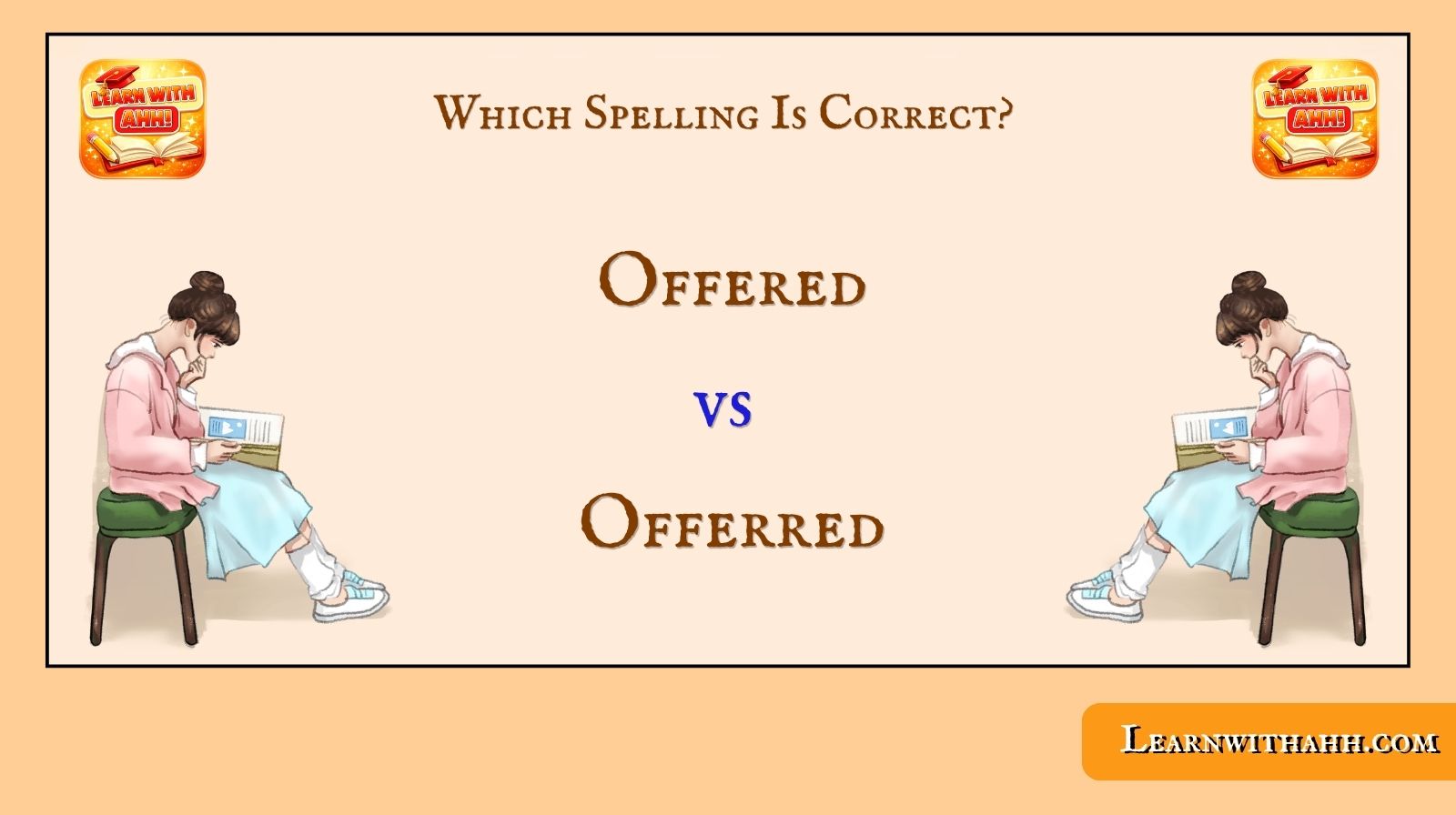
Have you ever paused while writing an email or an assignment because you were unsure whether to write Offered vs Offerred? You are not alone. English spelling can be confusing, especially when similar verbs follow different spelling patterns.
When comparing offered vs offerred, the answer is simple: offered is the correct spelling, while offerred is a misspelling in standard English.
The word offered is the past tense and past participle of the verb offer. It means that someone presented, suggested, provided, or made something available.
In this complete guide, you will learn why offered is correct, why offerred is incorrect, how to use the word in everyday sentences, and how to remember its spelling without confusion.
Quick Answer: Offered or Offerred?
- Offered Correct spelling.
- Offerred Incorrect spelling in standard English.
Example: The company offered me a new position.
Remember the simple formula: offer + ed = offered.
What Does Offered Mean?
The word offered is the past tense and past participle of offer. It describes an action in which someone presented something, suggested an idea, provided help, or made an opportunity available.
The exact meaning depends on the sentence. For example, offering someone a job means making employment available, while offering advice means sharing a suggestion or recommendation.
Meaning of Offered in Everyday English
Here are some common ways to use offered:
Context
Example
Help
She offered to help me.
Employment
The company offered him a job.
Food or drink
He offered me a cup of tea.
Advice
My teacher offered useful advice.
Opportunity
They offered her a chance to lead.
Money
The buyer offered a fair price.
In each example, offered describes something that was presented, suggested, or made available.
Offered as a Past-Tense Verb
Use offered when describing an action that happened in the past.
Examples:
- She offered me a seat on the bus.
- They offered a discount last week.
- My friend offered to drive me home.
- The school offered free English classes last summer.
These sentences describe completed actions. Therefore, offered is the appropriate past-tense form.
Offered as a Past Participle
The word offered also works as a past participle. It often appears with helping verbs such as has, have, had, was, and were.
Examples:
- She has offered her support.
- They have offered several solutions.
- He had offered to pay for dinner.
- I was offered a scholarship.
The spelling remains the same in all these examples: offered.
Offered vs Offerred: Why Is Offered Correct?
The main difference between offered and offerred is the extra letter r. Standard English does not double the final r in offer when adding the suffix -ed.
The correct word is formed by adding -ed directly to the base verb:
Correct spelling
OFFER + ED = OFFERED
The base verb already contains two f’s and one r. Simply add -ed without inserting another r.
Incorrect spelling
OFFERRED
This spelling contains an unnecessary extra r and is not the standard past-tense form.
Why People Write Offerred
The confusion often comes from other English verbs that double their final consonant before adding -ed.
For example:
- Refer → Referred
- Prefer → Preferred
- Occur → Occurred
- Offer → Offered
Because referred and preferred contain double r, writers sometimes assume that offerred must follow the same pattern.
However, English spelling rules depend on the structure and stress of a word. The final syllable of offer is not stressed, so the final r is not doubled.
Offered vs Offerred: Comparison Table
Feature
Offered
Offerred
Standard spelling
Correct
Incorrect
Accepted past tense of offer
Yes
No
Past participle
Yes
No
Standard formal writing
Yes
No
Extra r
No
Yes
The takeaway is simple: use offered in academic writing, business emails, blog posts, applications, and everyday communication.
How to Use Offered Correctly in Sentences
Understanding the meaning of a word is useful, but knowing how to apply it makes your writing more accurate. The word offered can appear in different sentence structures while retaining the same spelling.
Offered in Everyday Conversations
In everyday English, offered often describes kindness, help, or a suggestion.
Examples:
- My neighbor offered to carry my bags.
- She offered me some homemade cookies.
- He offered to explain the difficult question.
- They offered us a ride to the station.
These sentences show how offered describes an action that has already taken place.
Offered in Business and Professional Writing
The word is also common in professional communication, particularly when discussing jobs, services, contracts, and opportunities.
Examples:
- The company offered me a full-time position.
- Our manager offered a practical solution.
- The university offered her a research opportunity.
- The client offered a reasonable payment.
Using the correct spelling is especially important in professional documents because spelling errors can distract readers from your message.
Incorrect vs Correct Sentence Examples
Incorrect
Correct
She offerred me a job.
She offered me a job.
He offerred his assistance.
He offered his assistance.
They have offerred a discount.
They have offered a discount.
I was offerred a scholarship.
I was offered a scholarship.
The school offerred free classes.
The school offered free classes.
Notice that the sentence meaning does not change when the spelling is corrected. Only the unnecessary r is removed.
Offered vs Offerred: A Real-Life Writing Example

Spelling mistakes can happen even when someone understands a word perfectly. The following illustrative case study shows how a small spelling error can affect professional communication.
Case Study: Correcting a Job Application Email
Imagine a job applicant named Sarah who is preparing an email to accept a position at a company. She writes:
“Thank you for the opportunity. I am grateful that your company offerred me this position, and I look forward to joining the team.”
Sarah understands the meaning of offered and has used it in the right grammatical context. However, she has accidentally added an extra r.
Before sending the email, she reviews the message and notices the spelling mistake. She checks the correct past tense of offer and revises the sentence:
“Thank you for the opportunity. I am grateful that your company offered me this position, and I look forward to joining the team.”
The revised version uses the standard spelling and preserves Sarah’s intended meaning.
This example demonstrates an important writing lesson: knowing a word’s meaning is not always enough. Correct spelling is also part of clear, polished communication. A proofreading step can help catch small errors before they appear in job applications, business emails, academic assignments, or published articles.
The lesson is not that one spelling mistake automatically ruins an application. Rather, reviewing familiar words and checking uncertain spellings can help writers communicate with greater confidence.
English Spelling Statistics and Research: 2025–2026

What Does Current Evidence Tell Us?
When researching offered vs offerred, it is important to separate verified spelling information from general statistics about English writing.
As of 2026, the dictionary evidence for this particular word is straightforward: offered is the accepted past-tense and past-participle form of offer.
However, there is no verified, representative 2025–2026 statistic available here that establishes what percentage of English writers misspell offered as offerred. Giving a precise percentage without a reliable study would be misleading.
For a dependable spelling check, consult established dictionary references:
- Cambridge Dictionary: Offer Provides the definition and verb forms.
- Merriam-Webster: Offer Provides the word’s meaning and grammatical information.
These references support the standard spelling rather than a numerical estimate of how often the error occurs.
Why This Matters for English Learners
English spelling patterns can be difficult to generalize. The fact that preferred and referred double their final r does not mean every similar-looking verb does the same.
For learners, the practical takeaway is to verify unfamiliar forms rather than rely entirely on analogy. For editors and content creators, checking dictionary entries is a straightforward way to improve spelling accuracy.
FAQs
Q1: Is it offered or offerred?
A: Offered is the correct spelling. Offerred is a misspelling in standard English. The past tense of offer is formed by adding -ed without doubling the final r.
Q2: Why is offered spelled with one r?
A: The base verb offer already ends in r. When you add -ed, the spelling becomes offered. No additional r is needed.
Q3: Is offerred ever correct in English?
A: No. Offerred is not an accepted standard spelling of the past tense or past participle of offer. Use offered in both formal and informal writing.
Q4: What is the past tense of offer?
A: The past tense of offer is offered.
Example: “She offered me a helpful suggestion yesterday.”
Q5: What is the past participle of offer?
A: The past participle is also offered. It is used with helping verbs such as has, have, and had.
Example: “They have offered me a new opportunity.”
Q6: How do I remember the correct spelling of offered?
A: Use this simple formula:
Offer + ed = Offered
Remember that offer already has two f’s and one r. You do not need to add another r.
Q7: Is offered correct in British and American English?
A: Yes. Offered is the standard spelling in both British and American English. Offerred is not a standard alternative in either variety.
Q8: How do you use offered in a sentence?
A: You can use offered to describe something presented, suggested, or made available in the past.
Example: “The university offered her a scholarship.”
Conclusion:
When comparing offered vs offerred, the correct spelling is always offered in standard English. It is the past tense and past participle of offer, while offerred is an incorrect spelling with an unnecessary extra r.
Remember the simple spelling rule: offer + ed = offered.
Whether you are writing an email, completing a school assignment, preparing a job application, or publishing a blog post, using the correct form helps keep your writing clear and professional.
👉 Explore more useful grammar tips and guides on Learnwithahh

Zia Ahmad is a professional grammar blogger with a passion for clear communication, helping readers master English grammar and improve their writing skills with practical, easy-to-understand guidance.